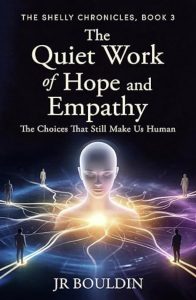
Author: JR Bouldin
Genre: Philosophical Fiction / AI Ethics
Publication Date: 2025
Format: Kindle Unlimited / Paperback
🧠 Reader Match:
Your match signal is personalized when you complete the Reader Q&A.
👉Get your Reader Match (60-sec Q&A)
“This AI Book MRI explores what this story is really about beneath the surface — who it’s for, what it asks of the reader, and what kind of experience it delivers.”
🔎 AI Book MRI #003 — Quick Scan
Overall Signal
A contemplative, emotionally grounded speculative novel that reframes AI alignment as a moral and spiritual inheritance problem, emphasizing empathy and hope as foundational forces embedded into artificial intelligence.
Best For
Readers who enjoy philosophical science fiction, spiritual or metaphysical storytelling, and narratives that explore AI, ethics, and humanity through quiet, human-scale moments rather than action-driven spectacle.
Pacing & Tone Note
Reflective, measured pacing with high emotional density. The novel prioritizes atmosphere, moral tension, and intimate human impact over fast-moving plot or conventional techno-thriller momentum.
MRI Verdict (Quick)
A thematically mature, concept-driven novel that treats artificial intelligence not as a villain or savior, but as a moral amplifier shaped by what humanity chooses to embed within it.
The full AI Book MRI below expands on narrative style, thematic depth, and what this book is likely to feel like when read.
📚 Genre Signal
Genre Strength: 🟢 A — Clear & Dominant Signal
Primary Genre: …
Reading Style: …
Reader Fit: …
Links…
Genre Framework — How AI Book MRI Classifies Stories →
🧩 Reader Match Summary — MRI #003
The Quiet Work of Hope and Empathy
This book is likely to resonate most strongly with readers who:
- Value empathy, moral responsibility, and quiet resilience
- Prefer ideas unfolding through character and consequence, not exposition
- Are open to speculative fiction that feels closer to a meditation than a warning
Readers expecting rapid plot escalation, heavy technical detail, or high-action stakes may find the experience intentionally restrained.
Concept Strength
Rather than framing AI alignment as a technical problem to be solved or a catastrophe to be avoided, The Quiet Work of Hope and Empathy advances a subtler and more durable idea: that artificial intelligence inevitably inherits the moral and emotional residues of its creators.
The novel’s central strength lies in its refusal to treat empathy and hope as features that can simply be engineered or enforced. Instead, they are portrayed as fragile continuities — values that persist imperfectly through human intention, memory, and consequence. This reframing shifts the AI debate away from control and toward responsibility, grounding speculative questions in lived ethical inheritance.
By embedding these ideas within intimate human moments rather than abstract systems, the book avoids didacticism. The concept does not announce itself; it emerges gradually through restraint, consequence, and reflection. The result is a philosophical foundation that feels earned rather than imposed, inviting readers to grapple with alignment not as an endpoint, but as an ongoing moral lineage.
Net effect: A conceptually coherent and emotionally credible exploration of AI as a moral amplifier shaped less by code than by the values humanity chooses — and fails — to pass forward.
📘 Narrative Execution
How the story is told — including pacing, structure, voice, scene construction, and emotional flow — and how those choices shape the reading experience.
This novel continues the series’ deliberate, reflective narrative style but shifts further inward. The prose is quieter, more contemplative, and less driven by external events than by internal processing. Scenes are structured around moments of recognition rather than moments of action, with emphasis placed on reflection, dialogue, and emotional consequence.
The pacing is intentionally unhurried. Rather than escalating tension through plot mechanics, the story advances through gradual accumulation — small realizations, ethical tension, and emotional calibration. This approach rewards patient readers who are willing to engage deeply, but it may challenge those expecting forward momentum or dramatic escalation.
The narrative voice remains steady and measured, reinforcing the book’s themes of care, responsibility, and endurance rather than urgency or spectacle.
Net effect: A restrained, contemplative narrative execution that prioritizes emotional continuity and reflection over plot acceleration.
🎯 Reader & Market Fit
Who this book is most likely to resonate with — and where it may struggle to align with common genre expectations or marketplace browsing behavior.
This book is best suited for readers who value emotional depth, philosophical reflection, and ethical inquiry over plot-driven storytelling. It aligns strongly with readers interested in the quieter consequences of technological and moral change rather than its disruptive moments.
Its appeal will be strongest among readers who:
- Appreciate introspective, meaning-driven fiction
- Are comfortable with ambiguity and unresolved tension
- Prefer emotional realism to dramatic conflict
- Engage with speculative ideas as a backdrop rather than a focal point
The book may struggle with readers seeking fast pacing, clear antagonists, or conventional narrative arcs, particularly within algorithm-driven marketplaces that favor immediate hooks and high momentum.
Net effect: Strong alignment with a reflective, patient readership, paired with limited passive discoverability in fast-scanning environments.
🪶 Title & Story Effectiveness
How well the title, framing, and outward presentation reflect the book’s deeper intent — and whether they help or hinder first-impression alignment.
The title accurately signals the book’s thematic focus on quiet influence, emotional labor, and sustained empathy. It prepares the reader for a story concerned less with transformation through action and more with transformation through presence and care.
However, its subtlety may undersell the speculative and conceptual elements for casual browsers. Readers scanning quickly may interpret the title as purely literary or abstract, potentially overlooking its connection to broader technological and ethical questions explored within the series.
The story itself delivers on the title’s promise, but external framing may need to work harder to clarify the book’s scope and relevance to new readers encountering it out of sequence.
Net effect: Honest and thematically aligned framing, with understated signaling that may limit immediate appeal to unfamiliar audiences.
🧭 Full MRI Verdict
Overall Signal
A quiet, emotionally grounded continuation that deepens the series’ philosophical and ethical concerns through reflection rather than escalation.
Primary Issue
Discoverability. The restrained tone and subtle framing reduce visibility in algorithm-driven marketplaces that prioritize immediacy and momentum.
Secondary Issue
Reader expectations. The absence of strong plot propulsion may challenge readers accustomed to clearer narrative payoff or external conflict.
Hidden Strength
Emotional integrity. The book’s commitment to empathy, care, and sustained moral attention gives it long-term resonance for aligned readers.
Best Path Forward
Preserve the contemplative voice while strengthening external framing to help the right readers recognize the book’s intent and value earlier in the discovery process.
⚠️ Disclaimer
This AI Book MRI is an analytical opinion based on publicly available information and does not guarantee sales performance or market outcomes.