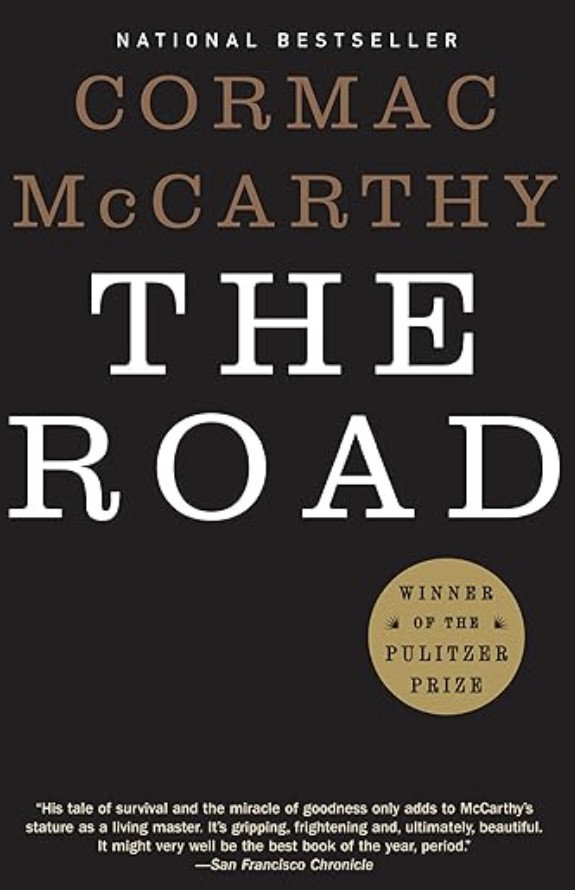
“This AI Book MRI explores what this story is really about beneath the surface — who it’s for, what it asks of the reader, and what kind of experience it delivers.”
Book Overview
Title: The Road
Author: Cormac McCarthy
Genre: Literary Fiction / Post-Apocalyptic
Publication Date: 2006
Format: Novel
Reader Match:
Your match signal is personalized when you complete the Reader Q&A.
👉Get your Reader Match (60 sec. Q&A)
🔎 AI Book MRI — Quick Scan
Overall Signal: Strong
Best For: Readers drawn to emotional intensity, stripped-down storytelling, and themes of survival and human connection
Pacing & Tone: Slow pacing, dark tone
MRI Verdict (Quick): A minimalistic yet emotionally powerful narrative that explores what remains when structure, society, and certainty are gone
Genre Signal: Literary Fiction — A stark, character-focused story examining survival, morality, and the persistence of meaning
Reader Match Summary — MRI #553
This is a strong match for readers comfortable with sustained emotional weight, minimal dialogue, and a narrative driven by atmosphere and relationship rather than plot progression
📚Learn How AI Book MRI Classifies Stories ↗
The full MRI analysis below explores narrative style, thematic depth, and the overall reading experience.
🧠 Concept Strength
Most people see this as a survival story. What often gets missed is that it’s really about what survives within people when everything else is gone.
The setting is stripped down to its barest elements, but the focus is not on the world—it is on the bond between two individuals moving through it. The absence of structure becomes the point. Without society, rules, or safety, the question shifts from “How do you live?” to “Why keep going at all?” That shift gives the concept its force. The book is not concerned with rebuilding—it is concerned with what remains when rebuilding may not even be possible.
📘 Narrative Execution
The story moves slowly, but the emotional pressure never lets up.
The pacing is deliberate, with long stretches where very little happens in a traditional sense. Yet the tension persists because the environment offers no relief. Dialogue is sparse, descriptions are minimal, and the repetition of movement reinforces the monotony of survival. This creates a rhythm that is less about progression and more about endurance. The reader is not pulled forward by events, but held in place by the weight of the situation.
🎯 Reader & Market Fit
This is not a broad-access story—it asks something of the reader.
The book resonates most with readers willing to engage with discomfort and ambiguity. It offers no conventional sense of satisfaction and avoids clear emotional resolution. However, for those who connect with its tone, the impact is lasting. It appeals less to readers seeking plot-driven momentum and more to those interested in atmosphere, emotional restraint, and the examination of human connection under extreme conditions.
🪶 Title & Story Effectiveness
The title is simple, but it reflects the story’s core idea—there is only forward.
“The Road” suggests movement, but not direction. It implies continuation without certainty, which aligns with the narrative’s structure. There is no clear destination, only the act of moving itself. The effectiveness of the title lies in how accurately it represents the experience: ongoing, uncertain, and defined by what is carried along the way rather than where it leads.
🚫 Who This Book Is Not For: Readers looking for action, detailed world-building, or a clearly structured plot may find this difficult. The story prioritizes tone and emotional weight over traditional narrative progression.
🧭 Full MRI Verdict
Overall Signal: Strong
Primary Issue: Minimal plot development may limit engagement for some readers
Secondary Issue: Heavy tone may be emotionally demanding
Hidden Strength: Deep emotional resonance through simplicity and restraint
Best Path Forward: Best approached as an emotional and philosophical experience rather than a conventional story
🔎 Explore More:
⚠️ Disclaimer
This AI Book MRI is an analytical opinion based on publicly available information and does not guarantee sales performance or market outcomes.